Global Pandemic & Vaccination
Some countries may stop their vaccination programs for a while to reduce the risk of spreading COVID-19. But which is better: fewer coronavirus infections or making sure children get all their usual vaccinations?

Introduction
The new coronavirus has caused many difficulties all over the world. Lots of people have become sick, and many have died. Many countries have taken measures to try to prevent the spread of SARS-CoV-2 coronavirus. A lot of us are in lockdown and some can't even go to the doctor unless it's urgent. But how far should these kinds of restrictions go?
For many years, we have defeated dangerous infectious diseases using vaccinations. (Unfortunately, as of November 2020 there is no licensed vaccine for COVID-19 yet as it's a new disease.) Since children are at high risk of falling sick from many infectious diseases, we usually receive vaccinations when we are children. Also, we are most likely to build up a good resistance to each disease in childhood. Vaccinations save lives and prevent the health complications that would come from catching the real diseases.
But what about during an epidemic? Going to the hospital or vaccination clinic poses many risks. Children or their carers could get infected with the SARS-CoV-2 coronavirus when they are in the clinic. They could then infect the entire household. Should we continue to give vaccines as usual? Or would everyone be better off staying at home? Which course of action will save the most lives? We wanted to find answers to these important questions.

Methods
We looked at all 54 African countries. We used a mathematical model to work out the benefits and risks if they carry on with vaccinations as usual. In our model we made some assumptions:
- The measures against COVID-19 include social distancing
- If a vaccine against COVID-19 is not discovered, the virus will eventually infect around 60% of the population
- The risk from COVID-19 lasts for six months
To work out the benefits of continued vaccination...
We estimated how many children would die from the time of the missed vaccinations until age five, if there were no routine vaccinations for 6 months.
To make a better assessment, we considered two extreme scenarios:
- Worst scenario: The risk from these diseases will be high until the children reach 5 years of age. Herd immunity doesn't protect the children. There will be no catch-up vaccination programs after the COVID-19 epidemic.
- Better scenario: Herd immunity will protect the unvaccinated children from the diseases – except for measles. There will be catch-up vaccination programs afterward.
To work out the risks of continued vaccination...
We calculated the extra exposure to the SARS-CoV-2 coronavirus that giving the vaccines could cause. We worked out the extra risk to the child, their caregiver, and their household members. We took into account the average household size and age composition in each country. This helped us to estimate the extra deaths among household members of vaccinated children, especially among the elderly people who are more likely to die from COVID-19.
Results
Risks of continued vaccinations:
Visits to vaccination clinics could cause an extra 8300 deaths from COVID-19. Very few of these deaths would be among the children and other young members of the households. Most of them would be among the oldest adults.
In our 'worst' scenario, we found that giving vaccinations as usual will prevent around 700,000 deaths in children. Measles and pertussis would have caused most of these deaths.
For every extra death due to COVID-19, vaccination will have prevented 84 deaths in children under five. This means the benefit-risk ratio is 84 (Fig. 1). If we focus only on the vaccinated children, for every extra child that would die from COVID-19, 85,000 other children will have been saved from death due to vaccine-preventable diseases.
In our 'better' scenario, the benefit-risk ratio of a sustained vaccination program is 3. For every extra death due to COVID-19, vaccination will have prevented three deaths in children under five. If we focus only on the vaccinated children, for every child that would die from the extra exposure to the SARS-CoV-2 coronavirus in the clinic, 3000 more will have been saved by vaccination.
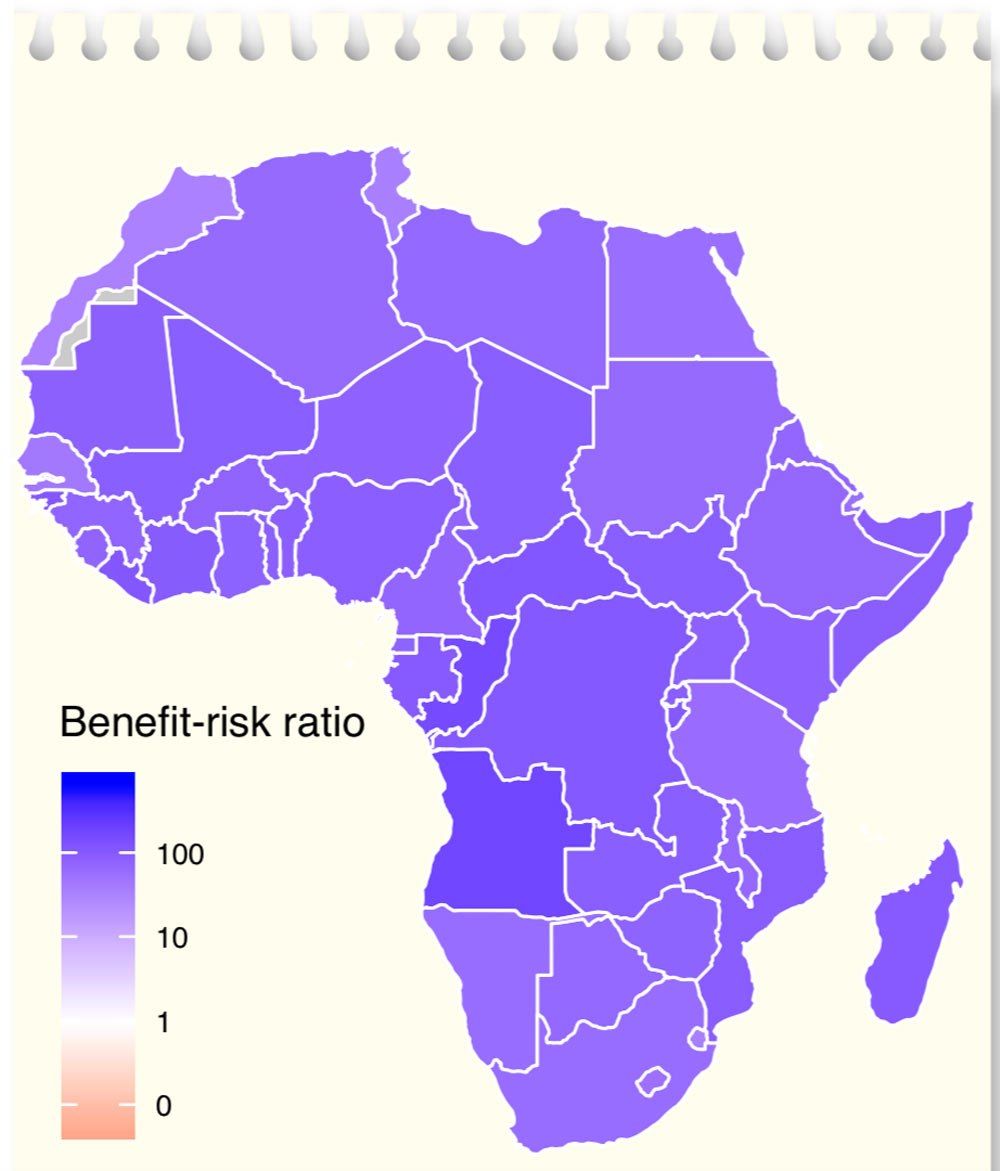
Figure 1:
Benefit–risk ratios if vaccinations for children continue as usual in Africa during the COVID-19 pandemic. This is under our ‘worst’ scenario – when the other diseases have a high impact. Grey = missing data.
Discussion
The benefits of carrying on with vaccinations as normal among children in Africa are far greater than the risk of extra deaths from COVID-19.
Many more lives will be saved by continuing with vaccination programs, despite COVID-19. This is true even if those other diseases have a lower impact (our ‘better’ scenario).
Furthermore, the extra exposure to the SARS-CoV-2 coronavirus in the vaccination clinic is mainly a risk to the older adults in the child’s household. Protecting the elderly is of great importance and may reduce these extra deaths.
Africa has one of the youngest populations in the world, which makes COVID-19 less severe there. On the other hand, there are risk factors in African countries which could make COVID-19 worse for people. For example, HIV, TB, and malnutrition can mean that people get sicker.
Since the benefits are far greater than the risks, we recommend that routine vaccinations should continue. At the same time, improved safety measures should be used to protect children, parents, and healthcare staff from the SARS-CoV-2 coronavirus. Safety measures in the vaccination clinics include patients keeping a distance of two meters apart, everyone wearing protective equipment (masks for patients and masks, gloves, and face shields for healthcare workers), and everyone washing their hands regularly.
Conclusion
When a lot of lives are on the line, it’s hard for health authorities to make decisions. This is where science can help. It may seem cold to assess lives as numbers, but it’s the best way to save as many people as possible – and keeping up with vaccination programs will do that.
The best way to help others right now is to keep a safe distance from each other. When you can’t keep your distance, you should wear a face mask. And remember to wash your hands regularly!
Well written
ReplyDeletegood
ReplyDeletePretty informative!
ReplyDeleteVery enlightening!!
ReplyDelete